Conceived and executed in the cool, desaturated style of a Saw movie, this remake is decidedly calculated. Its Jennifer Hills (Sarah Butler) is again a big-city writer roughing it in the country, but she's a contemporary woman: instead of spending the day lounging in a hammock or on a rowboat, she'll be out jogging in the morning and enjoying a glass of red wine in the evening.
Whenever I tell a certain kind of movie buff that Unknown is pretty good, they immediately want to know how it compares to Taken, that Liam-Neeson-as-killing-machine movie that made serious bank in the U.S. in 2009 despite having sat on the shelf for ages as bootleg copies proliferated on the Internet. The answer is that for all their similarities — the old-school action vibe, the European settings, the generally focused efficiency of narrative — they are also quite different.
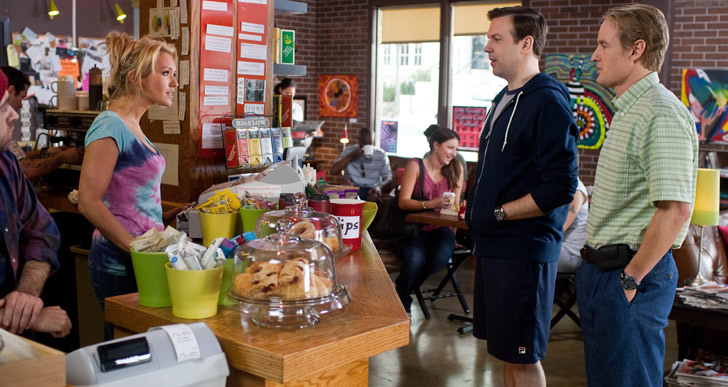
Neither as resolutely crass nor as offensively sexist as buzz might suggest, Hall Pass is pretty much what you'd expect of a remarriage comedy from the conservative Farrelly Brothers – a dopey but earnest endorsement of monogamy. Here, they cast Owen Wilson and Jason Sudeikis as Rick and Fred, 40ish suburban horndogs of the stripe that fantasize about the vigorous sex lives they might be enjoying had they remained single. Jenna Fischer and Christina Applegate are the wives who tolerate their ogling, childishness, and other dopey dudebro behavior, eventually issuing them hall passes in hopes of getting the overtly raffish behavior out of their systems.
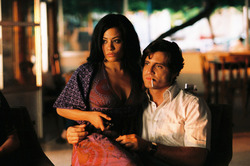
I don't believe in guilty pleasures, but if I did, Im Sang-soo's The Housemaid would surely be among them. This remake undermines the unsettling achievement of the iconic original film, made in 1960 by Kim Ki-Young, by constructing an explicitly classist framework for its characters. It replaces the Korean everyman at the center of the earlier film with a sexually smug cartoon character for whom wine and blow jobs are totems of his boundless leisure and power. By doing these things, it panders to an audience that craves victims and villains. It's a lesser achievement, and a more simplistic one. But it's glossy and lush and full of gorgeously decadent people doing their gorgeously decadent thing. In its way, it's a delight.
Staged almost entirely on green-screened sets, which are combined with miniature photography to occasionally amusing DIY effect, Repo Chick's every shot is ersatz. It shouldn't even be watchable, but writer-director Alex Cox manages to keep the cheese factor low and even brings a modicum of pizazz to the proceedings. It's a nominal sequel to Cox's 1984 cult film Repo Man, updated as a funhouse reflection of the mortgage crisis. In the title role, Jaclyn Jonet plays a pink-party-dress-clad heiress who's disinherited by her family due to generally Hilton-ish behavior and lands a job in repossession. Eventually, she falls into the clutches of a group of anti-golf terrorists. (Really!) The production values are bargain basement, but the performances are fairly sharp from top to bottom. Unfortunately, there's not a lot to work with in this too-familiar semi-satire, which is agreeably droll but never funny enough, smart enough or even punk-rock enough to really compensate for its embarrassingly Tosh.0 virtual-set approach to filmmaking. Good for Cox getting this made -- it's a better film than the plusher, superficially similar Southland Tales, for instance -- but I miss the sense of time and place of his early films and really hope this type of cartoonish digital artifact doesn't point the new cheapjack way forward for marginalized indie filmmakers.







 Easy A is a pleasant enough high-school movie, and it's certainly a sign of bigger things to come for the terrific Emma Stone, who tucks the whole film under her arm and runs with it. Stone plays the kind of teenaged girl who's as bright and hot as the noonday sun but is still a wallflower at her high school. In other words, she's a work of fiction – and one who starts getting noticed by her classmates only when she gains a reputation as a loose woman, displaying a red letter A on her chest.
 Scott Pilgrim vs. the World is an exotic multiplex confection – a romantic comedy with elements of its visual grammar swiped from comic books and videogames. It's tempting to say that people who are sick of conventional Hollywood love stories will find a bracing alternative here but, unfortunately, Scott Pilgrim isn't much of a love story, unless the affair you're interested in is the one between a boy and his cultural totems. If that's the case, Scott Pilgrim vs. the World should be hugely entertaining. It's a visual knock-out with the sensibility of a pinball machine, caroming from one set piece to the next, turning on lights and spinning little flippy things and ringing bells. It's not
  Perhaps funded and distributed on the promise of Christina Ricci in her skivvies and less, After.Life is weirdly compelling for such a marginal movie. Its premise is a little coy, toying with the expectations of audiences that have had their fill, lately, of stories with characters caught in some strange limbo between living and dying where they work out the psychological issues that hectored them in the real world.
 Count me among the great admirers of Todd Solondz’